Battery Spec Sheets Decoded: What 200%, 1C and “Under 4 ms” Really Mean
Home battery brochures are full of impressive numbers. Here is what 200% oversizing, 1C, 30 dB, 6-layer protection and sub-4 ms switchover actually change in your house.
Every home battery brochure leads with big numbers on a dark blue background. 200%. 1C. 30 dB. Under 4 ms. They look impressive, and almost none of them explain what they do for you on a Tuesday evening in July.
This guide translates the specs that actually change your experience. We use the GoodWe ESA Series figures as the worked example because it publishes all of them, but the same reading applies to any brand , the numbers are industry-standard, so you can hold two datasheets side by side once you know what you are looking at.
Capacity: kWh, and how much you actually need
Capacity is measured in kilowatt-hours (kWh) , how much energy the battery holds. A typical Australian household uses somewhere around 15–20 kWh a day in total, and roughly 8–12 kWh of that falls in the evening and overnight, when your panels have stopped producing.
That gives you a simple rule of thumb: around 10 kWh covers most homes' evening and overnight. You go bigger if you are all-electric, run ducted air conditioning, have a pool, or charge an EV at home. You go smaller if you are out most evenings or your usage is genuinely light.
Modular systems matter here more than the headline maximum. A range like "5–108 kWh" is not a suggestion that you buy 108 kWh , it means you can buy for the home you have now and add modules in three years when you get an EV or a heat pump, without replacing what you already installed. Ask whether new modules can be added to an existing stack, and whether different module sizes can be mixed. See kW vs kWh explained for the difference between size and speed.
1C: how fast the battery can move energy
C-rate describes how fast a battery charges or discharges relative to its own capacity. 1C means a 10 kWh battery can absorb or deliver 10 kW , it fills or empties in roughly an hour. A 0.5C battery of the same size takes about two hours.
This changes two real situations:
- Short winter days. If you only get a few good hours of sun, a 1C battery can still take a full charge in that window. A slower battery finishes the day part-empty.
- Everything on at once. Oven, air conditioning, hot water and an EV charger together can pull well over 10 kW. A fast battery carries that load; a slow one falls short and the shortfall comes from the grid at peak prices.
If you have a large home or an EV, C-rate deserves as much attention as capacity.
200% oversizing: fitting twice the solar
Normally the amount of solar you can install sits near the inverter's rating , around 10 kW of panels on a 10 kW inverter. Systems that accept 200% DC oversizing let you fit about double: roughly 20 kW of panels on that same 10 kW inverter.
That sounds wasteful until you look at how panels actually behave. They almost never produce their rated output. In early morning, late afternoon, winter and under cloud they might run at 20–40% of it. Doubling the panel area lifts that entire curve, so you generate usable power earlier and later in the day and fill the battery on days a smaller array would not.
The trade-off is clipping: on a perfect summer midday the inverter caps output and you lose the excess. For most Australian homes , where the pain point is the evening peak, not midday abundance , that is a good trade. It also means more MPPTs (three or four rather than two) are worth having, because they let panels on different roof faces perform independently.
Under 4 ms: the blackout switch you cannot feel
When the grid drops, a battery with backup has to disconnect your home from the grid and take over. How long that takes decides whether you notice.
- Under 4 milliseconds , four thousandths of a second. Faster than a light globe can visibly dim. Computers do not reboot, the modem stays online, the fridge never notices.
- A petrol generator , 10 to 30 seconds. Everything shuts down and restarts.
The second question is how much gets backed up. Many systems back up a handful of "essential" circuits only , a few lights, the fridge, one power circuit. Whole-home backup needs enough bypass current (a figure like 63 A) and, in a three-phase home, a system designed for three-phase backup. This is a design decision to raise early, not an afterthought. Our guide to single-phase vs three-phase power covers why.
30 dB: noise, and where you can put the thing
Batteries have cooling fans. A noisy unit on a bedroom or living-room wall becomes a daily irritation, and it is the kind of thing nobody thinks about until it is installed.
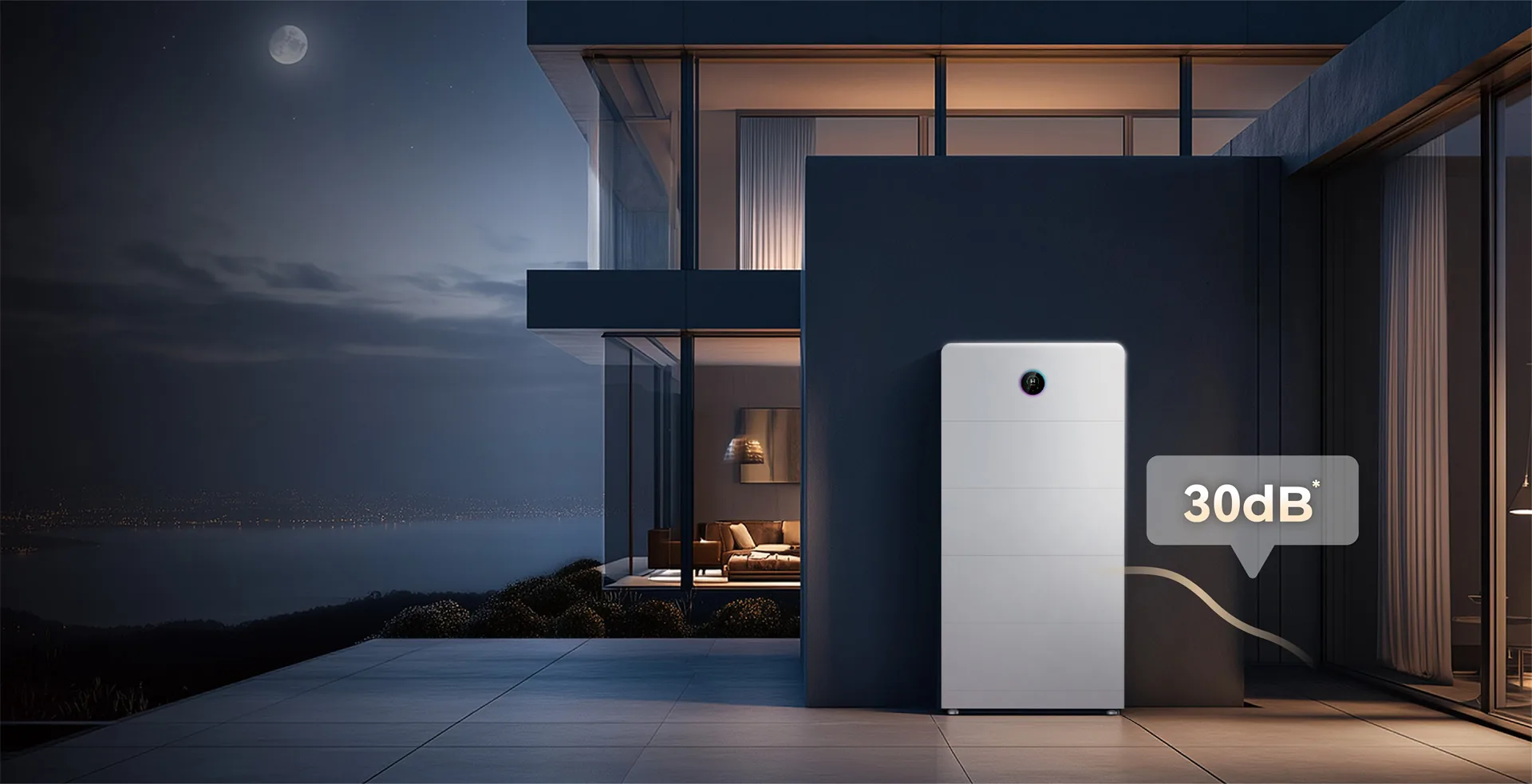
For reference: 30 dB is roughly a quiet library or a whisper across a room. A domestic fridge typically runs at 40–45 dB. Decibels are logarithmic, so 40 dB is not "a bit louder" than 30 dB , it is about ten times the sound intensity.
A quiet unit means you can mount it on the wall that suits your switchboard and cable runs, rather than paying for a longer cable run to put it out of earshot. Look for an independent certification (TÜV, for example) rather than a bare number.
"6-layer protection" and AFCI: what the safety claims mean
Safety marketing is where spec sheets get vaguest. Layered protection means safety is built in at several independent levels rather than resting on one device , typically the cell chemistry itself, electrical protection, the physical structure, continuous monitoring, system-level control, and emergency shutdown.
Two specifics are worth checking by name:
- LFP (lithium iron phosphate) chemistry. The most thermally stable mainstream lithium chemistry, and the standard for residential storage. It is far less prone to thermal runaway than the older NMC chemistry used in some earlier home batteries.
- AFCI (arc-fault circuit interrupter). Listens for the electrical arcing that starts DC fires and cuts the circuit before it spreads. This is a genuine fire-safety feature, not a marketing layer.
Beyond that, look for the certifications: IEC62619 and IEC63056 for the battery, and the Australian RCM mark. Anything sold and installed legally here should carry them.
"Up to 30% bill savings": read this one carefully
Savings claims are the least standardised number on any datasheet, because the baseline is rarely stated. A claim like "up to 30%" usually means 30% better than the same battery charging naively , not 30% off your whole bill.
What sits behind it is genuine, though. A battery only saves money based on when it charges and discharges. A smart energy management system reads the weather forecast, your household's usage pattern and your tariff, then plans each day: soak up solar before a forecast cloudy afternoon, top up on the cheapest overnight rate, hold charge for the 4–9 pm peak. That scheduling is worth real money, especially on a time-of-use tariff.
The honest way to evaluate it: ignore the percentage and ask whether the system schedules automatically, whether it uses weather and price data, and whether it re-plans as your habits change. Then ask your installer to model the saving against your bill.
"10-minute installation": why it still matters
You will see install-time claims on all-in-one systems. They refer to assembling the pre-wired stack itself, not the whole job , your installer still has switchboard work, mounting, commissioning and paperwork.
The underlying benefit is real anyway. Fewer hand-made connections on site means fewer of the loose-terminal and mismatched-component faults that cause callbacks years later, and less labour time shows up directly in your installed price. An IP66 rating is worth checking alongside it , it means the unit mounts outdoors without an enclosure, so it does not consume garage or shed space.
A short checklist for comparing two datasheets
- Usable kWh, not rated kWh , and whether you can expand later.
- C-rate (1C vs 0.5C) if you have a large home or an EV.
- Backup: switchover time and how many circuits, in amps.
- Chemistry (LFP), AFCI, and the certification list.
- Warranty: years, retained capacity percentage, and throughput in MWh.
- Noise, IP rating, and operating temperature range for where it will actually be mounted.
Once you can read those six lines, most of the dark blue marketing stops mattering. If you want help applying it to your own home, talk to Sunbridge , we will size a system against your actual bill and usage data rather than a brochure.
Thinking about solar, a battery or an EV charger?
Get a tailored quote , we'll design the system around your home, usage and rebates.