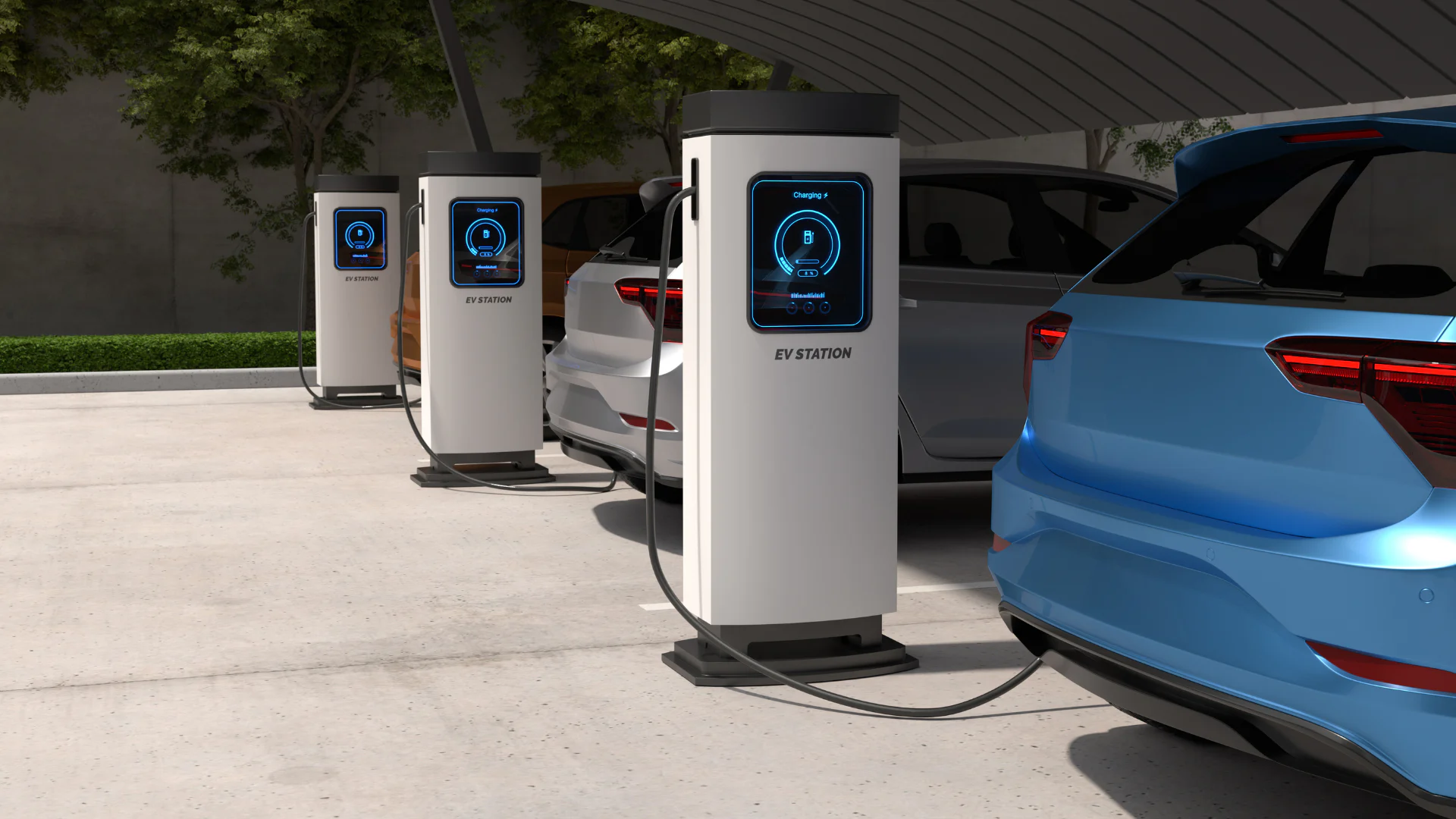
Commercial EV charging stations serving vehicles in an Australian car park

Commercial Property & Retail EV Charging

Plan EV charging for new developments, commercial car parks, retail destinations, hotels and customer-facing properties.

See How It Works →

  • Site capacity and load management
  • Commercial property and fleet planning
  • Accredited Australian installation

Where commercial charging works

Commercial EV chargers for the places people park

The right charger and operating model depend on who uses the site, how long vehicles stay and whether charging is private, shared or publicly accessible.

OF

Offices & business parks

Managed workplace EV charging for employees, visitors and company vehicles.

FL

Fleet depots & warehouses

Operational charging for vans, utes and fleet vehicles returning on planned schedules.

HC

Hospitals & healthcare sites

Charging strategies for staff, visitors and operational vehicles at high-demand facilities.

RT

Retail centres & supermarkets

Customer charging selected around shopping dwell time, access and payment needs.

HT

Hotels, resorts & hospitality

Overnight guest charging, visitor access and destination charging for hospitality properties.

CP

Commercial car parks

Shared or paid charging supported by compatible monitoring, access and billing platforms.

LG

Councils & local government

Charging for council fleets, employees, community facilities and suitable public destinations.

AP

Apartments & mixed-use buildings

Scalable charging for residents, tenants, visitors and shared building infrastructure.

Commercial EV charging

Make EV charging part of the property strategy

For a development, early planning can protect cable routes, switchboard space and future charger capacity before construction makes changes more expensive. For an operating property, the design must work around existing tenants, customers and building demand.

Retail and hospitality sites also need a clear operating model. Charging may be offered as an amenity, restricted to selected users or supported by compatible payment and access functions. The right choice depends on dwell time, customer experience and commercial objectives.

Designed for the site

What a considered solution can achieve

EV-ready planning

Coordinate electrical infrastructure and cable pathways with the wider project team.

Better customer experience

Match charging speed and access to how long customers or guests typically stay.

Clear operating model

Define who can charge and whether usage needs to be monitored, allocated or billed.

Future expansion

Plan switchboard, communications and parking infrastructure for additional chargers.

Planning decisions

What must be resolved before installation

Property developers, builders, asset managers, shopping centres, hotels and commercial car park operators

01

New build or retrofit

Construction stage, existing services and planned tenancy changes affect the most practical infrastructure pathway.

02

Dwell time

A hotel guest, supermarket customer and commuter car-park user have different charging needs.

03

Access and payment

Card payment, app access and private-user controls require compatible hardware, software and network connectivity.

04

Whole-site demand

EV charging must be coordinated with lifts, HVAC, kitchens, refrigeration and other significant building loads.

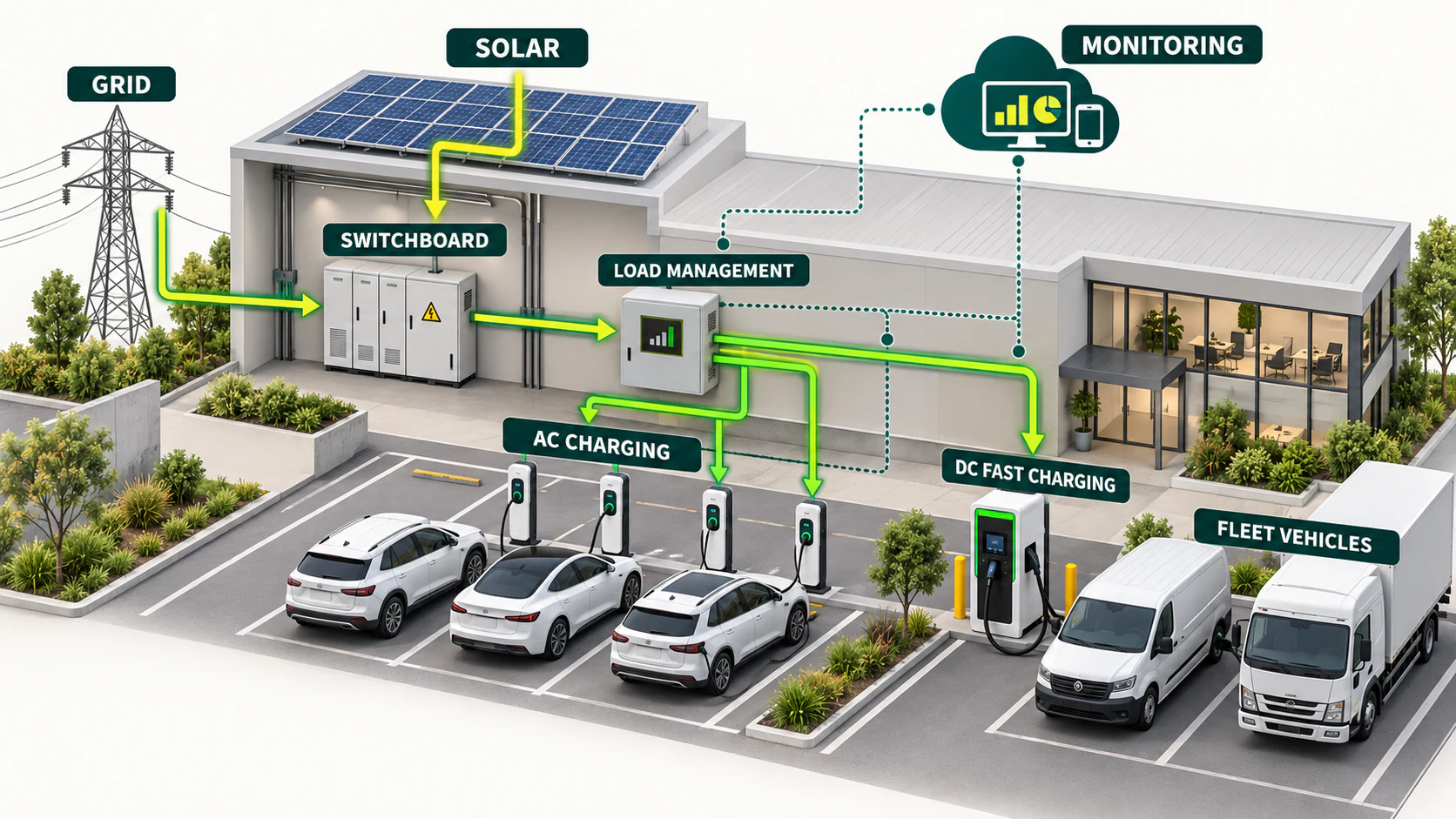
System architecture

How a commercial EV charging system fits together

Chargers are the visible part. Capacity, controls and data determine whether the whole site works reliably.

Commercial EV charging system showing grid and rooftop solar feeding a switchboard and load management system, which supplies AC workplace chargers, a DC fast charger and fleet vehicles, with cloud monitoring
Typical commercial charging architecture. The final electrical design and available charging power depend on the assessed site.

The building load comes first

Load management can reduce or redistribute EV charging when other building demand approaches the agreed site limit.

AC or DC depends on dwell time

Long workplace parking often suits managed AC charging. Short fleet turnarounds may justify DC charging when site capacity supports it.

Plan for data and future V2G

User access, monitoring and reporting need compatible software and communications. Future V2G also requires supported vehicles, bidirectional hardware and network approval.

Government funding and guidance

Check eligibility before relying on an EV charger rebate

There is no universal Australian rebate for every commercial property. Programs are targeted by state, applicant type, vehicle use and charging model, and their status can change.

AUSTRALIA-WIDELIMITED ELIGIBILITY

DRIVEN Charger Rebate Stream

Designed for eligible automotive dealerships and EV repairers. It does not apply to every office, hotel, shopping centre or commercial car park.

Check DRIVEN on business.gov.au →
NSW FLEETSOPEN TO 30 NOV 2026*

EV Fleets Incentive: Kick-start Funding FY26

Eligible NSW fleet operators may be able to include smart AC or DC charging support with eligible battery-electric vehicle projects. This is a fleet incentive, not a general property rebate.

Check the NSW Government program →
NSW PROPERTYOFFICIAL GUIDANCE

Commercial buildings EV-ready guide

Official guidance for owners, tenants, facility managers and property managers planning EV-ready commercial buildings.

Read the NSW commercial guide →
NSW DESTINATIONSROUND 3 CLOSED

Destination charging grants

Round 3 closed on 28 March 2025. Use the official page for program history and future updates; do not assume a site is currently eligible.

Check destination charging updates →
VICTORIAAPPLICATIONS CLOSED

Destination Charging Across Victoria

The Victorian program funded public fast charging at tourist and high-use locations, but it is closed to new applications. The official page records funded projects and future policy updates.

View the Victorian program →
VICTORIA FREIGHT2026 ROUND CLOSED

Freight decarbonisation co-investment

The 2026 program included eligible charging infrastructure for qualifying freight decarbonisation projects. Applications closed in July 2026; monitor the official page for later rounds.

Check Victorian freight funding →
QUEENSLANDPROGRAM CLOSED

EV Charging Infrastructure Co-Fund Scheme

Queensland’s public fast-charging co-fund scheme is closed and the administering authority states there are no planned further rounds. Gold Coast businesses should not treat it as a current rebate.

View the Queensland scheme →
QLD & GOLD COASTFUNDING FINDER

Queensland business grants and support

No general commercial EV charger rebate is currently listed for Queensland or the Gold Coast. Use the official Queensland grants finder to monitor future state and regional opportunities.

Search Queensland business support →

*Published closing dates may move or funding may be exhausted early. Sunbridge does not determine eligibility or guarantee funding. Always confirm current guidelines before committing to equipment or installation.

From assessment to operation

A practical commercial charging process

1

Usage brief

Define vehicles, users, parking time, charging priorities and future growth.

2

Site assessment

Review switchboards, demand, phases, cable pathways, communications and parking layout.

3

System design

Select charging speeds, load controls, access functions and a staged infrastructure plan.

4

Installation and support

Complete compliant installation, commissioning and the agreed ongoing support setup.

FAQ

Commercial Property & Retail EV Charging FAQs

Site-verified planning

Plan commercial EV charging with confidence

Share the site address, parking use and expected vehicle demand. Sunbridge will assess the electrical infrastructure and recommend a practical next step.