
Three-Phase Home Battery Backup: What Must Be Designed Before You Buy
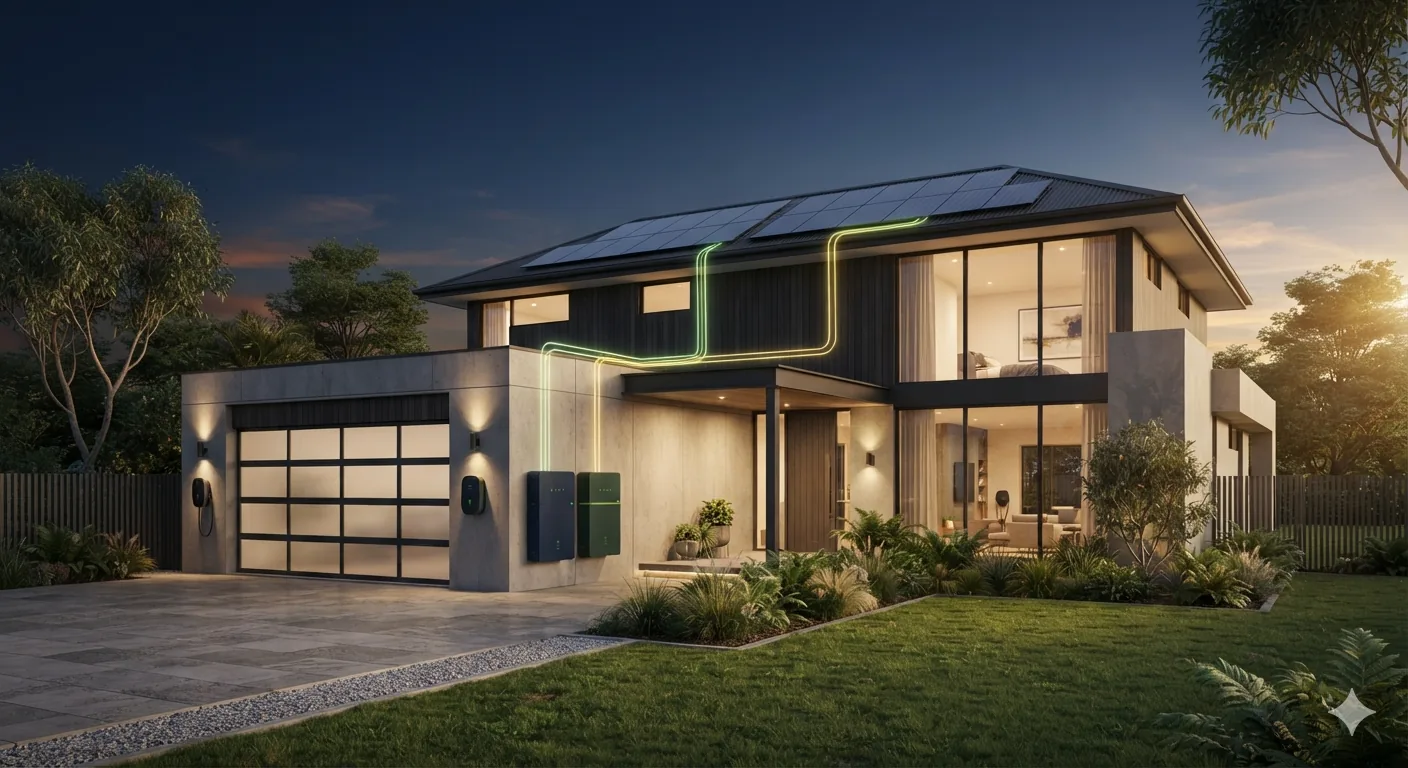
A large headline inverter rating does not guarantee strong backup on every phase. Check phase limits, surge loads and essential circuits before buying.
Battery backup is not automatically whole-home backup. That distinction becomes especially important in an Australian property with three-phase power, where the inverter's total output may be divided across three phases while individual appliances remain connected to only one.
A system can therefore have a respectable headline rating and still trip when a large air conditioner, pump or cooking appliance starts on one phase. The right question is not only “How many kilowatts is the inverter?” It is “Which circuits will operate during an outage, how much power is available on each phase, and what happens when a motor starts?”
Why the total inverter rating can be misleading
A nominal 10 kW three-phase inverter does not necessarily make 10 kW available to one appliance. If output is evenly distributed, the starting assumption is about one-third of the total on each phase. Some equipment permits a defined amount of phase imbalance, so the exact per-phase limit must come from that model's backup specification rather than a generic rule.
This is why a three-phase home needs a phase-by-phase load assessment. The installer should identify the circuits, normal running demand and short startup surges that the backup supply must support.
Continuous output and surge output are different
Fridges, pumps, compressors and some air conditioners can briefly require much more power when starting than when running. Battery and inverter specifications should show both continuous backup output and surge capacity, including how long the surge can be sustained.
Battery capacity in kilowatt-hours answers how long energy may last. Inverter output in kilowatts answers how much equipment can run at once. A large battery paired with an undersized backup inverter can still shut down under a short, heavy load.
Essential-load backup may be the better design
Backing up every circuit can require a larger inverter, more battery modules and switchboard work. Many homes get a more predictable result by placing selected essential loads on backed-up circuits: refrigeration, lighting, internet, selected outlets and other agreed priorities. The exact arrangement depends on the chosen inverter, battery, switchboard and phase configuration, so it must be documented in the site-specific design.
High-demand equipment such as ducted air conditioning, ovens, pool heating and EV chargers may remain outside the backup supply unless the system is deliberately sized for them. See our guide to stopping an EV from draining a home battery for the same load-priority principle applied to charging.
What to ask for in writing
- Is the property single-phase or three-phase?
- How much continuous backup power is available on each phase?
- Which exact circuits will remain powered during an outage?
- What surge power is available, and for how long?
- Can solar continue charging the battery while the grid is down?
- How will the system restart after an overload or a depleted battery?
Which Sunbridge battery is the stronger fit?
There is no honest winner without the home's phase arrangement and load profile. Within the systems Sunbridge supplies, two options stand out for different three-phase priorities.
GoodWe ESA three-phase is the stronger starting point when backup power range and system scale lead the brief. GoodWe's Australian datasheet lists 5–30 kW inverter models, battery expansion from 5 to 108 kWh and an internal 80 A bypass intended to support a whole-home backup design. Those figures do not mean every appliance can run without limit; the selected inverter size, battery modules, per-phase loads and surge requirements still control the result.
EcoFlow OCEAN 2 three-phase is the stronger fit when the household wants battery storage, solar control and EV charging inside one coordinated ecosystem. EcoFlow publishes 6, 8, 10 and 12 kW three-phase inverter options, a 63 A whole-home backup path, expansion up to 12 battery modules on one inverter and integration with its home-energy controls. Its advertised 0 ms load-side switchover applies only under EcoFlow's stated supported grid and load conditions, so it should never be repeated as an unconditional promise.
Our practical view: choose GoodWe when a larger three-phase inverter range and high-capacity expansion are central to the design. Choose EcoFlow when an integrated solar, storage and PowerPulse 2 charging experience is the higher priority. For either brand, the site assessment decides the final model and backed-up circuits.
Sunbridge checks the switchboard, phase arrangement, battery location and intended backup loads before finalising a system. Compare our home battery options, or book an inspection so the backup design is matched to the property rather than a headline product number.
Sources and further reading: GoodWe Australia, ESA three-phase datasheet; EcoFlow Australia, OCEAN 2 three-phase specifications; EcoFlow Australia documentation centre; Australian Government, Solar PV and batteries; SolarQuotes discussion of three-phase backup design. Product specifications checked 11 September 2026.
FAQ
Frequently asked questions
Thinking about solar, a battery or an EV charger?
Get a tailored quote , we'll design the system around your home, usage and rebates.


